Illustrative image only. Not representative of the client's actual brand or product.
Residential HVAC Provider

End-to-End Field Service, From the First Call to Payment On Site

Replacing phone-driven scheduling and thin service data with one Field Service workflow that connects dispatchers, technicians, estimators, and customers.

Date
August 7, 2026
Topic
Field Service
Summary

This residential HVAC provider scheduled work through repeated phone calls between customers and dispatchers, on a legacy platform that captured little about customers, their equipment, or service history. We implemented Salesforce Field Service across the full service visit: scored dispatch suggestions, a mobile technician workflow for multi-tier quoting and on-site payment, case-based routing to expert estimators, and automated customer arrival notifications. Each job now runs from request to payment in one system, without calls back to the office.

Focus Areas
Field Service, Mobile Quoting, Dispatch Optimization
Challenge

Every stage of a service visit depended on phone coordination, while the underlying platform recorded little of what happened.

  • Reactive work management: scheduling relied on repeated calls between customers and dispatchers, so work was managed reactively rather than planned.
  • Limited customer data: the legacy platform supported field quoting but captured little about equipment age, condition, or service history, which limited marketing and the customer experience.
  • Delayed job reporting: technicians were surveyed about completed jobs only after being dispatched to their next assignment.
  • Manual estimator search: when a job needed a full replacement estimate, schedulers had to make multiple calls to find an available estimator.
Solution

We implemented Salesforce Field Service as one connected workflow covering every stage of a service visit, from the customer request through payment on site.

  • Level-based dispatch: work orders created by customer service carry the technician level the job requires, and dispatchers schedule from scored candidate suggestions or by hand. We matched technicians by level rather than by individual job type, which kept dispatchers able to make judgment calls and avoided maintaining a large skills list.
  • Automated customer ETA updates: customers receive notifications with the technician's live location when the technician leaves the prior appointment and again within one mile of the site.
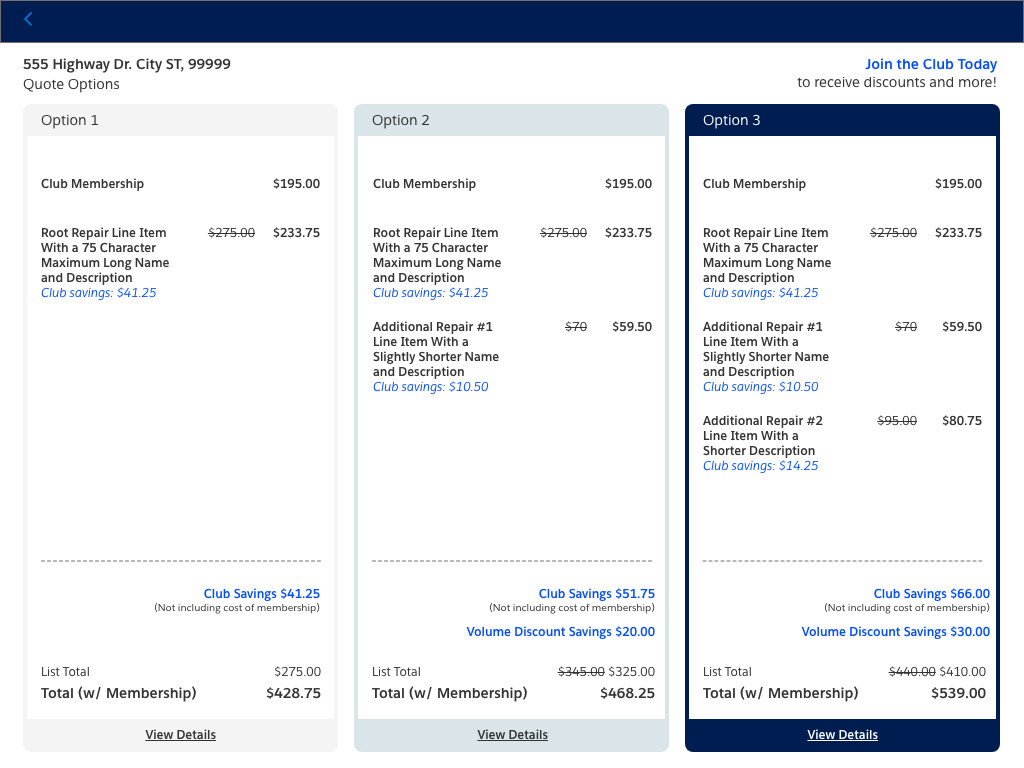
  • On-site multi-tier quoting: technicians build multi-tier options on their mobile devices, so customers can choose on the spot.
  • Equipment tracking: technicians record the work performed along with equipment age and condition directly in Salesforce.
  • Replacement routing: jobs that need a replacement estimate automatically open a case and dispatch an expert estimator.
  • On-site close-out and payment: technicians report progress in real time and collect payment when the job is complete.
Results

One field service operation, run from one platform

  • Complete service history: customer interactions, equipment details, and payments are stored in Salesforce instead of spread across phone calls and separate systems.
  • Better-informed customer calls: service representatives review equipment age, condition, and service history before speaking with customers.
  • Structured scheduling: dispatchers match technicians to jobs by technician level, candidate score, and availability rather than by phone.
  • Faster on-site close-out: technicians quote, report, and collect payment at the customer's home.
  • Direct estimator routing: replacement estimates go to expert estimators through automated cases, with no dispatcher phone search.
  • Fewer status calls: automated arrival alerts replace many of the "when will the tech arrive" calls.
End-to-End
Request intake, dispatch, quoting, and payment in one system
Zero
Calls back to the office to report a completed job
Live ETA
Arrival alerts with the technician's real-time location
We connected dispatchers, technicians, estimators, and customers in one Field Service workflow, so each service visit runs from request to payment without a call back to the office.